Finance & Reserves · By Mayowa Ogunmola, CMCA · November 21, 2026
How Big HOA Management Companies Actually Make Money: Inside the Incumbent Playbook
Why do national incumbents like FirstService Residential, Associa, and RealManage often bid surprisingly low base monthly fees? Public filings show only 16% of FirstService Residential’s revenue comes from base fees, while 84% comes from back-end services.
Most large HOA management incumbents, including giants like Associa, RealManage, and private-equity-backed regional roll-ups, are privately held, so volunteer boards rarely get to inspect their internal profit math. FirstService Corporation (NASDAQ / TSX: FSV), the parent of North America’s largest residential manager FirstService Residential, is an exception: because it is publicly traded, its executives report directly to shareholders every quarter on where revenue actually comes from.
That makes FirstService Residential’s October 2026 Investor Presentation and Q3 2026 Earnings Call Transcript (October 22, 2026) an unusually clear window into how large established incumbents operate. Below, we walk through their exact numbers and words simply, not to single out one company, but so your board understands the financial engine driving big management companies before signing a contract.
1. Slide 8: The One Industry Chart Every HOA Board Member Should Read
FirstService Residential manages more than 9,500 communities (including 3,800 high-rise condos) with roughly 20,000 employees and $2.3 billion in annual revenue. On Page 8 of their October 2026 Investor Presentation, they show investors a three-pie breakdown of where that $2.3 billion originates.
Look closely at the bottom pie chart titled “2025 Revenue By Service ($2.3BN Total)”:
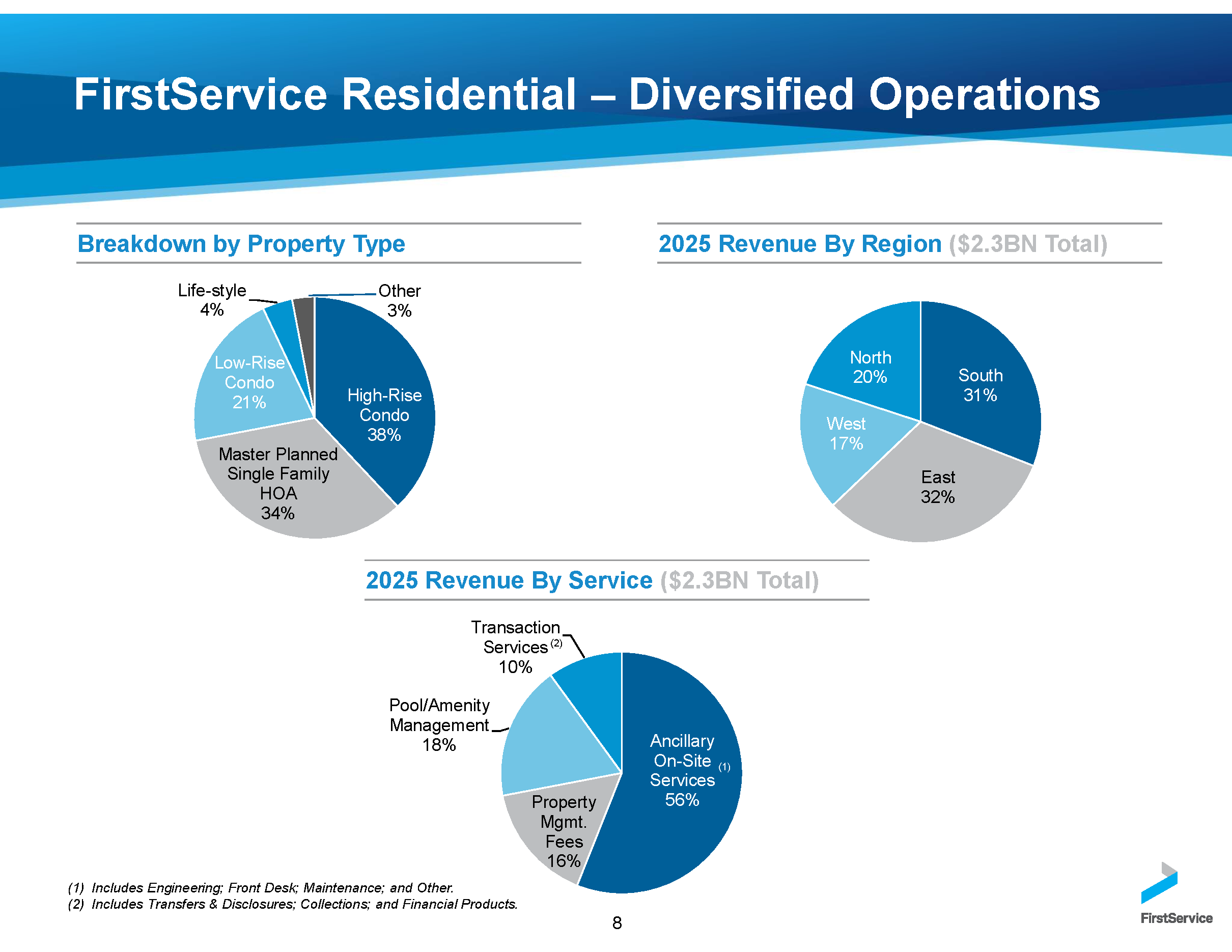
You do not need a finance degree to read that bottom pie chart. Out of every $100 the business collects:
| Revenue Slice (Slide 8) | Share of $2.3B | Estimated Dollars | What It Means for Your HOA |
|---|---|---|---|
| Property Mgmt. Fees | 16% | ~$368 million | The monthly base fee boards debate during interviews: the “sticker price” on page 1 of a proposal. |
| Ancillary On-Site Services (1) | 56% | ~$1.29 billion | Building engineers, front desk staff, porters, and on-site maintenance crews billed back to the HOA (commonly carrying payroll/benefits overhead plus 10% to 15%+ labor markups). |
| Pool / Amenity Management | 18% | ~$414 million | Lifeguards, clubhouse operators, fitness attendants, and seasonal pool maintenance contracts layered on top of basic management. |
| Transaction Services (2) | 10% | ~$230 million | Resale disclosures, transfer fees when homes sell, delinquency collection charges, plus banking and insurance financial products. |
Put simply: across large-scale HOA operators, the base property management fee is only the front door. It works like an affordable printer at an office store; the real business margin is generated from everything attached to the contract afterward.
2. Why Large Incumbents Chase High-Rises and Master-Planned Communities
Look at the top-left pie chart on Slide 8 again: High-Rise Condos (38%) and Master Planned Single Family HOAs (34%) together make up 72% of the portfolio.
Why do mega-firms like FirstService, Associa, and RealManage compete so aggressively for a 400-home master-planned HOA or a downtown high-rise? Because large properties need front-desk concierges, full-time building engineers, clubhouse crews, pool attendants, and dozens of home sales every year, which unlocks the 84% back-end revenue engine.
Listen to how FirstService Corporation’s President and CEO, D. Scott Patterson, described this industry dynamic to analysts on the October 22, 2026 Q3 earnings call:
Later during Q&A on the same call, an analyst asked how management wins contracts when HOA bidding is so competitive on base fees. Patterson laid out the logic clearly:
What this means for boards: Because competing on the headline monthly fee is cutthroat across the entire industry, large incumbents stay aggressive on base pricing while steering toward complex properties where on-site labor, amenities, and transaction fees supply higher profit margins.
3. How Corporate Margin Grows: Labor Optimization, Add-Ons & Financial Spreads
Once a large incumbent wins a community (note that Slide 7 highlights a “Mid-90%+ contract retention rate” under the bullet “Sticky customer base; Consistent cash flow profile”), the institutional priority is expanding profitability year over year for shareholders or private equity owners.
In Q3 2026, FirstService’s CFO Jeremy Alan Rakusin explained how profit grew faster than revenue:
Look at Slide 16 of the investor deck (“Growth Strategy”): expanding non-fee revenue is listed explicitly under both organic growth and M&A: “Continue to Expand our Ancillary Services” and “Property Management Ancillary Services.” Meanwhile, in Q3 alone, the parent company repurchased “2.2 million shares at a cost of a little more than $300 million” (p. 4).
For an everyday board member reading their HOA’s monthly income statement, here is how those back-end profit levers show up at nearly every major management company:
- On-Site Labor Overhead & Markups (10% to 15%+): When a large firm places an on-site engineer, front-desk concierge, or maintenance tech at a community, the HOA doesn’t just reimburse raw hourly wages. Contracts typically layer an administrative burden for payroll and insurance plus an extra 10% to 15%+ management markup on the total labor bill. When executives talk about “optimizing labor costs,” it can also mean stretching salaried portfolio managers across more HOAs or routing homeowner calls through centralized call centers.
- Transfers, Disclosures & Collections (10% of Revenue): Every time a neighbor sells or refinances, buyers and sellers pay hundreds of dollars for resale disclosure packets, lender questionnaires, and transfer entries. Late-payment demand letters and delinquency referrals carry separate administrative schedules billed to homeowners or the HOA.
- Banking, Insurance & Procurement Spreads: Slide 6 of the presentation spells out what sits inside Transaction Services: “Transfers & Disclosures; Collections; Financial Products (banking, insurance); Energy Management / Procurement.” Across national operators, including FirstService, Associa, and RealManage, pooling billions of dollars in HOA operating and reserve cash creates banking, treasury, and insurance revenue streams that boards rarely see on their monthly base invoice.
- Sister-Company & Affiliated Vendor Networks: Large platforms frequently build or acquire service affiliates around their HOA footprint. FirstService’s sister division, FirstService Brands ($3.2 billion in 2025 revenue, Slides 10 & 15), owns major restoration, roofing, fire-protection, and painting brands including FIRST ONSITE, Paul Davis, Roofing Corp of America, Century Fire Protection, and CertaPro Painters. Other incumbents run sister maintenance divisions or “preferred vendor” compliance portals that charge contractors to stay on the bid list.
4. How Associa, RealManage & Other Large Players Adapt the Playbook
FirstService Residential is simply the clearest case study because Wall Street requires them to publish their pie charts. Across the industry, other national and regional incumbents, including Associa, RealManage (backed by institutional real estate/equity owners), CCMC, and large regional management groups, pursue the exact same economic structure tailored to property size:
- The High-Volume “Low Base Fee + Heavy Admin Schedule” Model: When a large incumbent manages mid-size townhomes or suburban HOAs without front desks or full-time engineers, they cannot bill 56% of revenue as on-site labor. Instead, they bid an eye-catching $10 to $14 per unit per month base fee, then attach a 3-to-5-page Exhibit A fee schedule charging $25 to $65 per violation letter, $125 to $250/hour for evening board meetings after 5 PM, $0.50 to $1.25 per printed page, monthly “technology infrastructure” charges, and separate billing for annual elections.
- The “Vendor Compliance Portal” Model: Many national managers require local landscapers, roofers, and plumbers to pay $300 to $1,500+ annual compliance enrollment fees, plus a 5% to 10% platform fee on every invoice. Contractors naturally bake that extra 10% into their bids to your HOA.
- Strategic Pruning of Lower-Margin Accounts: Notice CFO Jeremy Rakusin’s remark in Q3 2026 about lifting margins by “exiting noncore aquatics operations earlier this year” (p. 4). Whenever an institutional operator decides a smaller HOA or service line isn’t clearing corporate margin hurdles, boards frequently face steep renewal hikes or sudden non-renewals.
Key takeaway for boards: If your 150-unit community receives one proposal for $1,900/month from a large incumbent and another for $3,200/month, do not assume the $1,900 bid will actually save homeowners money. If real accounting, dedicated senior attention, insurance, and admin support cost more than $1,900/month to deliver properly, the gap is almost always made up elsewhere: through stretched 20-HOA manager caseloads, back-end fee schedules, on-site labor markups, closing/transfer charges, or vendor portal rebates.
5. Five Questions Every Board Should Ask Before Signing a Contract
Before selecting a management partner, and especially as California’s AB 739 requires boards to review all annual fees paid to their managing agent, put these five direct questions in front of every company interviewing for your HOA:
- “Can you give us a binding 12-month all-in dollar cap?” Ask every bidder to fold base fees, evening meetings, postage, software portals, violation processing, and annual elections into one guaranteed annual number.
- “Do you mark up on-site staff payroll or collect any fees from our contractors?” Request a written warranty confirming whether they charge percentage markups over raw labor costs or require vendors to pay compliance/referral fees.
- “How many communities does our assigned day-to-day manager oversee right now?” When companies “optimize labor costs,” managers are routinely assigned 15 to 25+ HOAs. Require a portfolio cap in writing.
- “What are your resale disclosure, demand, and transfer fees?” Even if buyers or sellers pay at closing, extreme transfer charges still hit your neighbors and slow down real estate transactions.
- “Who earns the interest and bank credits on our HOA’s operating and reserve cash?” Your association’s money should sit in dedicated accounts titled solely in your HOA’s name with full rate transparency.
6. Comparing the Traditional Incumbent Model vs. Steward
Boards don’t switch away from national incumbents because volunteer directors want perfection. They switch because they are tired of high manager turnover, unexpected Exhibit A invoices, and feeling like small fish inside a billion-dollar revenue machine.
| How Incentives Work | Large Established Incumbents (FirstService, Associa, RealManage, etc.) | Steward’s Boutique Model |
|---|---|---|
| Who They Answer To | Public shareholders, private equity sponsors, quarterly margin expansion targets, and acquisition roll-ups. | Independent, privately held ownership: our growth depends solely on retaining the boards we serve. |
| Where Revenue Comes From | Low base management fees offset by heavy back-end ancillary services, labor markups, transfer fees, and financial products. | Transparent, predictable flat monthly fee covering board meetings, financial reporting, and day-to-day oversight. |
| Vendor & Labor Pricing | Commonly utilizes on-site labor markups, vendor compliance portal fees, or sister-company contractor ecosystems. | $0 vendor kickbacks, $0 portal fees, and competitive local bidding passed straight to your board at true cost. |
| Manager Workload | Often 15 to 25+ associations per manager with centralized call centers to contain corporate labor cost. | Strict 5-HOA cap per senior community lead with direct phone/email access and a 48-business-hour SLA. |
| Banking & Bookkeeping | Pooled treasury relationships or delayed monthly PDF packets. | 24/7 live Vantaca financials and dedicated FDIC-backed association accounts at Western Alliance Bank. |
Want to audit every fine-print trap inside Exhibit A of typical HOA contracts? Explore our Board Contract Audit Guide.
How Steward Restructures the Relationship
Steward was founded explicitly to eliminate the misaligned incentives of corporate HOA management. We operate on three fundamental principles:
Our managers handle a maximum of 5 communities, not 20. Your lead manager actually answers their phone and knows your property.
We accept $0 from contractors. Every vendor bid is passed to the board at true cost with 100% fiduciary transparency.
Evening meetings, electronic ballots, and regular correspondence are all included in one predictable monthly rate.
Want Us to Audit Your Current Management Contract?
Send us your current management agreement and fee schedule. A Steward co-founder will walk your board through every hidden add-on line by line with zero obligation, and show you what a clean flat-fee partnership looks like.